
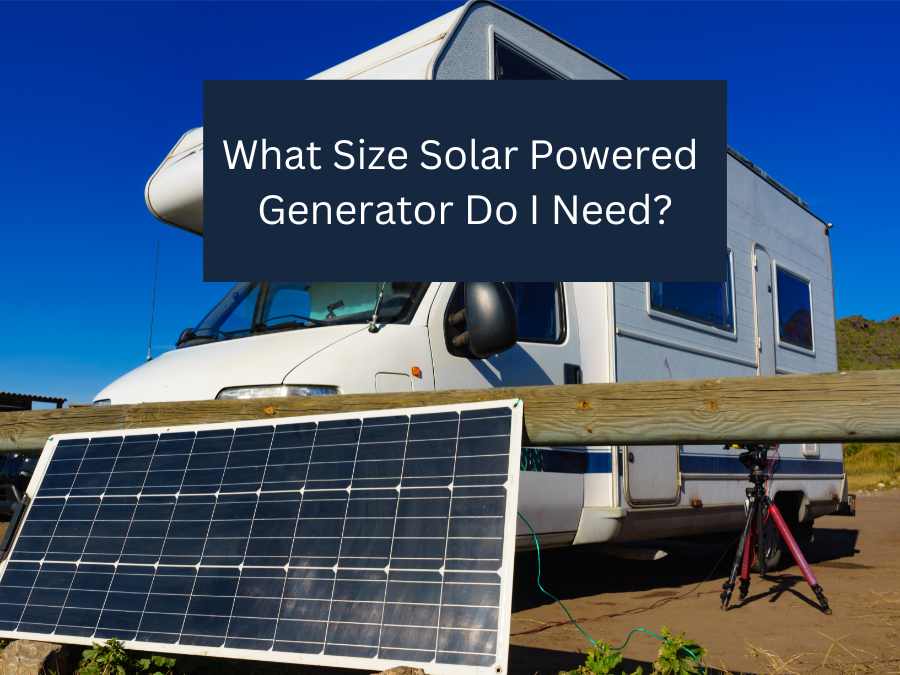
What Size Solar Generator Do I Need?
I have reviewed several portable power stations and solar generators recently, but one area I want to dive deeper into is calculating the size and wattage of the generator you need.
The importance of reliable power has never been more evident. Whether it’s for everyday conveniences, emergency preparedness, or sustainable living, finding the right source of energy can be a pivotal decision.
Choosing the right size solar generator is crucial to ensure it efficiently meets your power needs. The size of the generator you need depends on several factors, including your power requirements, location, and how you plan to use it. In my real-world guide, I will explain how to determine the size of the solar generator you need, with examples of what it can power in various scenarios.
1. Calculate Your Power Requirements:
Before you choose the size of your solar generator, you need to determine your power requirements. Make a list of all the appliances and devices you intend to power using the generator. For each item, note its wattage, which can typically be found on a label or in the product’s user manual.
Example Appliances and Their Wattages:
- Laptop: 50-100 watts
- LED TV: 50-200 watts
- Refrigerator: 100-800 watts (varies by size and efficiency)
- Microwave: 600-1200 watts
- Air Conditioner: 1000-5000 watts
2. Estimate Daily Energy Usage:
Once you have a list of your appliances and their wattages, estimate how many hours each item will be in use during a typical day. Multiply the wattage by the number of hours to calculate the daily energy consumption for each device.
Example:
- Laptop (100 watts) used for 4 hours: 100 watts x 4 hours = 400 watt-hours (Wh) per day
3. Total Daily Energy Consumption:
Add up the daily energy consumption for all your devices to find the total daily energy requirements. This will give you an estimate of how much energy your solar generator needs to produce in a day.
Example:
- Laptop (400 Wh) + LED TV (300 Wh) + Refrigerator (1200 Wh) = 1900 Wh or 1.9 kWh per day
4. Account for Efficiency and Extra Capacity:
Solar generators are not 100% efficient, and you should account for losses due to conversion and storage. A good rule of thumb is to add about 20-30% extra capacity to your daily energy consumption estimate to ensure your generator can meet your needs, especially on cloudy days.
Example:
- 1.9 kWh + 30% = 2.47 kWh per day
5. Consider Your Location:
Your location plays a significant role in determining the size of the solar generator you need. Sunlight availability varies by region and season. Use tools like solar irradiance maps or consult local solar experts to understand how much sunlight you can expect in your area.
6. Battery Capacity:
The battery capacity of your solar generator is critical. It should be large enough to store the excess energy generated during sunny days for use during cloudy or nighttime periods.
7. Portability vs. Stationary:
Consider whether you need a portable solar generator for outdoor activities or a stationary system for backup power at home. Portable generators are typically smaller in capacity.
8. Examples of Solar Generator Sizes and What They Can Power:
Small Portable Generator (300-500 Wh):
- Charging small electronics (phones, tablets).
- Powering LED lighting.
- Running small household appliances such as:
- Desk fans.
- Electric razors.
- Cordless phone chargers.
- CPAP machines for sleep apnea patients.
- Providing power for outdoor activities, camping, or picnics.
- Running a portable speaker or radio.
Medium Portable Generator (1000-1500 Wh):
- Charging multiple devices simultaneously (phones, tablets, laptops).
- Running a LED TV and a laptop.
- Providing backup power for a mini-fridge or small chest freezer.
- Powering a microwave for quick heating of meals.
- Running small power tools like drills and saws.
- Keeping a fish tank or aquarium running.
- Running small space heaters in cold weather.
- Charging electric scooters or e-bikes.
Home Backup System (5-10 kWh or more):
- Powering essential appliances during an outage:
- Refrigerator.
- Lights throughout the house.
- Televisions and entertainment systems.
- Heating or cooling systems (depending on capacity).
- Washing machines and dryers.
- Running power tools for home improvement or DIY projects.
- Charging electric vehicles (EVs) overnight.
- Powering water pumps for wells or irrigation.
- Running larger space heaters or air conditioners.
- Running a home office with multiple computers and printers.
- Charging power-hungry devices like electric lawnmowers.
Off-Grid Cabin or Remote Area (10-20 kWh or more)
- Providing power for an entire off-grid home or cabin.
- Running heavy-duty appliances like large refrigerators, freezers, and ovens.
- Powering a water heater for showers and cooking.
- Operating well pumps for a water supply.
- Running large power tools for construction or workshops.
- Charging multiple electric vehicles or a fleet of electric tools and equipment.
- Supporting a home with a full complement of electrical needs, including air conditioning and heating, without reliance on the grid.
Remember that your specific needs may vary, so it’s essential to customize the size of your solar generator to match your individual requirements. Regularly monitor your energy consumption and adjust your setup if necessary to ensure it meets your needs effectively. Investing in a solar generator that suits your needs will provide you with reliable and sustainable power for years to come.
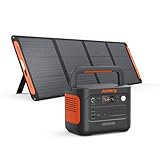
- Powerful yet Compact: Boasting a 1,500W AC output and a 3,000W surge peak, the Solar Generator 1000 V2 can power multiple appliances, including AC units, fridges, and electric pots. With a 1,070Wh capacity and a lightweight build of only 23.8 lbs, along with a foldable handle, it makes an excellent companion for outdoor camping, road trips, and emergencies.
- One Hour Fast Charging: Charge your Explorer 1000 v2 Portable Power Station from 0% to 100% battery level in just one hour with emergency charging activated via the Jackery App. It defaults to 1.7 hours for a full charge to optimize battery health. Engineered with advanced ChargeShield 2.0 technology, this power station charges safer, faster, and smarter.
- 10 Year Lifespan: The Explorer 1000 v2 portable power station is equipped with a durable LFP battery, maintaining over 70% of its original capacity even after 4,000 charge cycles, offering longevity exceeding 10 years.
- Tailored for Versatility: Featuring two USB-C ports, one USB-A port, one DC car port, and three pure sine wave AC ports, along with LED lights, the Solar Generator 1000 V2 is capable of charging multiple devices simultaneously, meeting power needs in various scenarios. PD 100W fast USB-C charging ensures a rapid charging speed, even without power adapters.
- Smart App Control: Effortlessly switch between different charging modes with Jackery’s App—including one hour emergency charging from 0 to 100%, 30 dB quiet overnight charging mode, and energy efficiency mode. Maximize the freedom to adjust the power station to meet your needs.
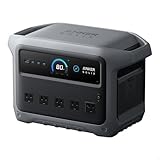
- 49 Min UltraFast Recharging: With upgraded HyperFlash tech, fully recharge at 1,600W—for outage prepping, camping trips, or tailgating events. Enable it in the Anker app.
- 2,000W Output via 10 Ports: Delivers 2,000W (3,000W peak) and 1,024Wh capacity. Power up to 10 devices—ideal for emergency backup, remote work setups, tiny homes, and off‑grid living.
- Compact and Portable: Easily carry, store, and move from room to room, your RV, or even on beach and park outings. C1000 Gen 2 is 14% smaller and 11% lighter than similar models.
- 10 Years of InfiniPower: Built to last through years of daily backup and RV and van life. After 4,000 cycles, the battery still has at least 80% capacity.
- 1.8 Hr Solar Recharging: Go fully off‑grid with sustainable power for tiny homes, camping RV off‑grid setups, and remote locations. Plug in 600W (60V max) of solar and recharge in just 1.8 hours.
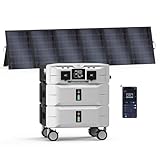
- [5120Wh High Capacity. 5000W Output]–IEE solar powered generator has a capacity of 5120Wh and provides 5*AC output, 5000W(Surge 9000W), Suports DC/AC Bi-Directional Inverter 120V/240V Dual Voltage Output,ensuring that any appliance can find its match with this device. In the case of an unplanned outage, all the charging outlet demands of the family will be satisfied with its 16 outlet sources. Whether camping, working outdoors, or facing an emergency, this solar generator can provide stable power.
- [3500W Fast Charging] 0-100% in 1h with 3500W AC input and 1000W solar input. IEE SP5000 uses a 3500W bi-directional inverter, you will get a fast charging speed while using AC charging cable.The capacity from 0% to 100% can be completed within 1.5 hour.
- [Long-Lasting LiFePO4 Battery]–Our portable power station relies on durable and stable LiFePO4 batteries supported by an advanced eight-layer safety BMS. With protections against overcharge, over-discharge, over-voltage, over-current, short-circuit, and temperature fluctuations, enjoy peace of mind while experiencing up to 4000 charge and discharge cycles, ensuring a service life of up to 25 years.
- [5-8 ms Fast Switchover]–Equipped with EPS uninterruptible power supply, when there is a power outage or power interruption, it will automatically switch to the built-in battery power supply within 5-8 ms., keep your equipment up and running. Perfect for home emergencies, network equipment, and outdoor tasks requiring uninterrupted power supply.
- [[APP Control]–Download the IEE application on your smartphone to effortlessly pair and control the portable power station through. Monitor power usage and execute remote commands with ease.
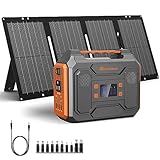
- Portable Generator with 60W Solar Panel Included: with a superior battery pack, ZeroKor 300W power stations Generator are powerful enough to charge smartphones,tablets,laptops,headphones or other outdoor Small Camping supplies (Tips:Using electrical appliances over 300W may damage the portable solar generator, especially some devices that are prone to heat or built-in air compressor such as coffee maker,Hair dryer, water pump etc )
- Multiple Charging outlets for camping gear with SOS Flashlight: with 2* 110V/300W Max AC outlets, 1* DC port (9V-12.6V/10A max ), 3* 5V/3A MAX USB ports, 1*quick charge USB port (5V/3A 9V/2A Max), Flashlight with reading mode and SOS mode for your outdoor Adventures, our portable solar power station offers a versatile charging solution,allowing you to charge your devices directly from a wall AC outlet
- Multiple Charging Optional, Solar Panel 60W Included: ZeroKor portable power bank generator can be recharged by wall AC outlet, DC5521 Solar Panel (Portable Power Station built-in MPPT), Carport. Take the portable generator with you on-the-go and never worry about power shortage,the portable AC outlet design makes it more suitable for Tent camping OFF-Grid life
- Configure Multiple Protection Mechanisms: Built in BMS, ZeroKor portable power station features short circuit protection, over-current protection, over-voltage protection, overload protection and overheating protection. The built-in cooling fan system will automatically start and stop according to the portable battery pack internal temperature during use. Acting as a portable solar power bank, it accommodates multiple devices simultaneously, making it perfect for indoor and outdoor use
- HIGH CONVERSION EFFICIENCY: ZeroKor solar panels 60W monocrystalline solar cell have a high conversion efficiency of 20.5%, and its performance is better than that of polycrystalline solar panels under the condition of insufficient light

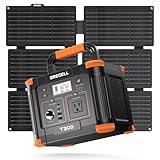
- 【230.88Wh Solar Generator with 40W Panels Included】 GRECELL 300W portable power station with 40W foldable solar panel delivers 330W (600W surge) pure sine wave AC for laptops, mini-fridges, CPAP devices, and more. The 230.88Wh high-capacity battery and solar combo ensures off-grid power for camping, road trips, and blackouts—40W solar input cuts recharging time while staying eco-friendly.
- 【Ultra-Fast Charging & 6-Port Versatility】 Charge 6 devices at once: 1x AC outlet, 1x USB-C PD 60W (2X faster for laptops/phones), 1x USB-C PD 18W, 2x USB-A QC 15W, and 1x car port. The 40W solar panel with built-in MPPT maximizes sun energy, while AC/car charging offers 3 flexible power sources.
- 【Lightweight & Safe for Outdoor Adventures】 230.88Wh + 40W Solar Kit, 330W Power Station Weighs only 7.3lbs + 2.93lbs (solar panel)—lighter than competitors. Upgraded BMS protects against overload, overcharge, and short circuits. Dual silent fans ensure safe temperatures even during 8-device operation.
- 【Solar Panel Features】 The portable charging station attached to the solar generator is portable and foldable(like the same size as 13in laptop),weight: 2.93lbs; fold size: 11.97*7.12*1.7 inch; unfold size: 20.69*23.81*0.7 inch. it brings about versatile options of charging and recharging. This solar panel is equipped with 1 DC output port.
- 【 Solar Generator with Panels Included Complete Kit for Any Emergency】 Includes: 1x 330W power station, 1x 40W solar panel, AC adapter, MC4 connector, user manual. Perfect for camping, RV trips, or home backup. GRECELL’s 24/7 support and 2-year warranty guarantee peace of mind.
Choosing Between a Solar Generator and a Gas Generator:
When it comes to selecting a power generator, whether it’s for backup power, outdoor activities, or off-grid living, you’ll often have two primary options: a solar generator and a gas generator. Each has its advantages and disadvantages, and your choice should be based on several key factors:
1. Environmental Impact:
- Solar Generator: Solar generators are environmentally friendly as they harness energy from the sun, a renewable resource. They produce no greenhouse gas emissions, noise, or air pollution during operation.
- Gas Generator: Gas generators, on the other hand, run on gasoline or propane, emitting small amounts of carbon dioxide. They sometimes can contribute to air and noise pollution.
2. Fuel Availability:
- Solar Generator: Solar generators rely on sunlight, making them suitable for locations with ample sunshine. They are particularly ideal for sunny regions and off-grid setups.
- Gas Generator: Gas generators require a steady supply of fuel (gasoline, propane, or natural gas). Access to fuel can be challenging during emergencies or in remote areas.
3. Noise Level:
- Solar Generator: Solar generators are virtually silent during operation since they have no moving parts. This makes them suitable for quiet environments, camping, and residential areas.
- Gas Generator: Gas generators can be noisy due to their internal combustion engines. This noise can be a concern in quiet settings or neighborhoods.
4. Maintenance and Longevity:
- Solar Generator: Solar generators have minimal maintenance requirements. Solar panels can last for 25 years or more, and other components have a long lifespan with little wear and tear.
- Gas Generator: Gas generators require regular maintenance, including oil changes, air filter replacements, and fuel stabilization. They also have a finite lifespan and can experience mechanical failures.
5. Portability:
- Solar Generator: Solar generators come in portable options, making them suitable for outdoor activities and camping. However, their portability may be limited by the weight and size of the solar panels and batteries.
- Gas Generator: Gas generators are available in portable and stationary versions. Portable gas generators are typically heavier and noisier than their solar counterparts.
6. Cost Considerations:
- Solar Generator: Solar generators have higher upfront costs due to the purchase of solar panels and batteries. However, they have lower operating costs since sunlight is free.
- Gas Generator: Gas generators generally have lower upfront costs but higher operating costs due to fuel expenses. Additionally, the price of fossil fuels can be volatile.
7. Backup Power Needs:
- Solar Generator: Solar generators are suitable for providing backup power to essential devices and appliances during short-term power outages. Their capacity may be limited by the size of the solar array and battery storage.
- Gas Generator: Gas generators can provide higher power output and longer runtime, making them suitable for extended power outages and running multiple appliances simultaneously.
8. Location and Grid Connectivity:
- Solar Generator: If you live in an area with unreliable grid power or want to go off-grid, a solar generator can be an excellent choice for sustainable energy independence.
- Gas Generator: Gas generators are typically used as backup power sources in areas with frequent power outages or where grid power is essential.
In summary, the choice between a solar generator and a gas generator should be based on your specific requirements, environmental considerations, and location. Solar generators are more environmentally friendly and require less maintenance but have limitations in terms of power output. Gas generators are versatile and can provide higher power levels but come with maintenance drawbacks. Assess your priorities and circumstances to determine which generator type best suits your needs.

Blair Witkowski is an avid watch nut, loves pocket knives and flashlights, and when he is not trying to be a good dad to his nine kids, you will find him running or posting pics on Instagram. Besides writing articles for Tech Writer EDC he is also the founder of Lowcountry Style & Living. In addition to writing, he is focused on improving his client’s websites for his other passion, Search Engine Optimization. His wife Jennifer and he live in coastal South Carolina.