
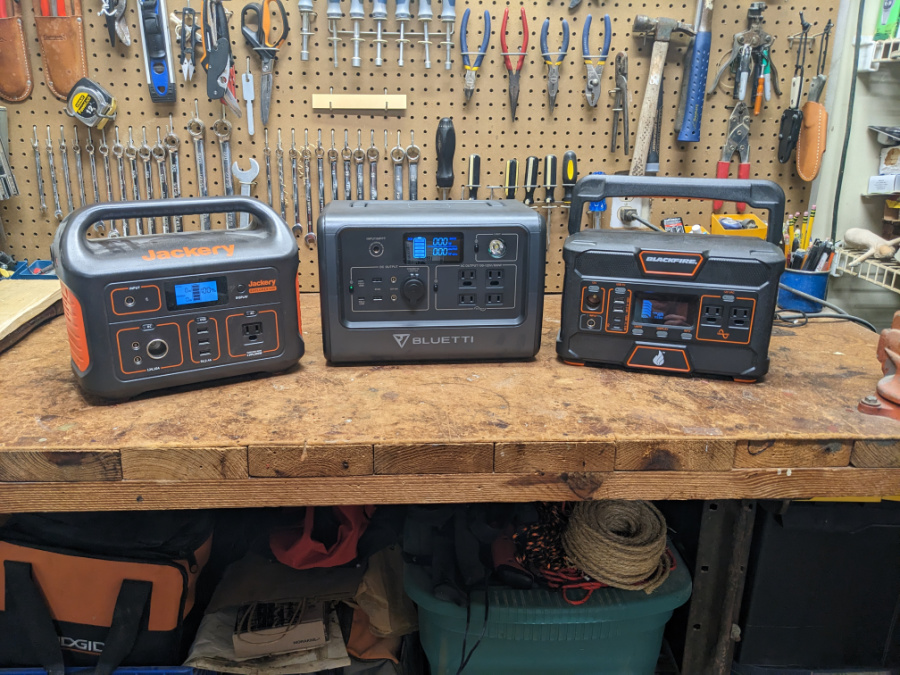
Best Portable Power Stations: Real-World Picks I Actually Trust & Use
Updated December 2025: One of my first portable power stations was a BLUETTI EB70S that cost around $350. After a year, it stopped holding a charge.I’d plug it in overnight, the display would show 100%, but within 24 hours it would be dead.
That failure taught me the most important lesson about these units: battery quality determines whether you own a useful tool or an expensive paperweight.
I’ve since tested power stations that don’t even exist anymore—like the Blackfire 500W I reviewed head-to-head with a Jackery—and owned several that are still running strong years later. Living in South Carolina through increasingly severe hurricane seasons, reliable backup power shifted from “nice camping gear” to essential household equipment.
When the grid goes down for days with nine kids at home, being able to run refrigeration, charge medical devices, and keep Starlink connected isn’t optional.
I currently own five power stations and have used dozens more through camping friends who depend on their gear as much as I do. What I’ve learned: specs lie, marketing exaggerates, and most “best of” lists are just repackaged Amazon rankings.
Battery chemistry matters more than capacity. Fast recharge beats oversized batteries. Continuous output is what actually counts, not surge ratings.
This isn’t a generic roundup. Every power station here earned its place through real-world use—either mine or from people I trust when storms hit.
To BLUETTI’s credit, their newer models with LiFePO4 batteries are completely different from my failed EB70S, and two of them made this list. Size is flexible within trusted brands, but reliability isn’t negotiable.
Here are the portable power stations that actually deliver when you need them.
How I Chose These Portable Power Stations
Every power station on this list earned its place through real-world use, not spec-sheet comparisons or paid placements. Some of these units I personally own and rely on.
Others belong to close friends who camp and prepare the same way I do, and I’ve used them extensively during trips, outages, and storm season.
My selection criteria was simple:
- Real use over marketing – Units had to perform reliably during camping trips, extended outages, or emergencies.
- Battery quality first – LiFePO4 battery chemistry was prioritized for long-term reliability and cycle life.
- Honest power delivery – Continuous output mattered more than inflated surge ratings.
- Proven brands – I focused on manufacturers with a real track record, not flashy hardware.
- No paid rankings – This list isn’t sponsored, and placement isn’t for sale.
If a power station didn’t hold up when it actually mattered or came from a brand I wouldn’t trust long-term, it didn’t make the cut.
Jackery Explorer 300
Best For: Backpacking, short trips, lightweight power for essential electronics
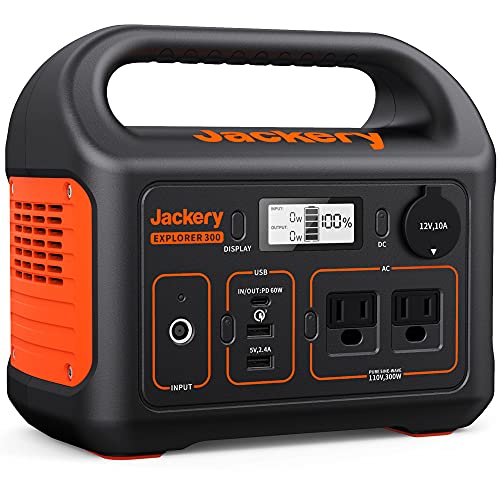
- SPEED UP YOUR RECHARGEABILITY: It takes only 2 hours to recharge 80% battery of the power station through the wall outlet and 60W PD USB-C port simultaneously. You can also recharge your power station with an AC adapator when at home, through the car outlet during a road trip or simply use a Jackery SolarSaga 100.

I’ve had this unit for 2.5 years and it’s been my go-to for backpacking overnights and day trips where I need more than just a battery bank but don’t want to lug 20+ pounds. At 7.1 pounds and 293Wh capacity, it strikes a solid balance between portability and usability.
It’ll charge my Pixel Phone about 15 times, keep my Garmin inReach running for days, and power a headlamp or small USB fan without issue. I tried running a small electric cooler off it during a car camping trip—lasted maybe 3 hours before it drained. It’s not built for running anything with a compressor, but for keeping essential electronics charged, it does exactly what I need.
The one caveat: it uses standard lithium-ion batteries instead of LiFePO4, so I’m realistic about its lifespan. After 2.5 years it’s still performing well, but I expect I’ll eventually need to replace it before my LiFePO4 units show any degradation.
Why I Picked It: When you need something light enough to actually carry but powerful enough to keep your essentials running for a weekend, this is the sweet spot.
Jackery Explorer 1000
Best For: Family car camping, CPAP use, multi-day trips, reliable storm backup
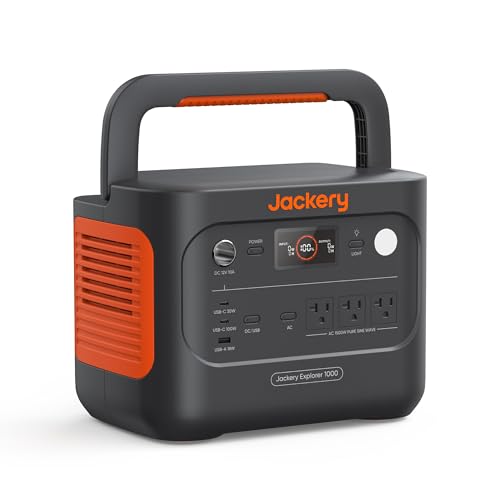
- Powerful yet Compact: Boasting a 1,500W AC output and a 3,000W surge peak, the Solar Generator 1000 V2 can power multiple appliances, including AC units, fridges, and electric pots. With a 1,070Wh capacity and a lightweight build of only 23.8 lbs, along with a foldable handle, it makes an excellent companion for outdoor camping, road trips, or emergencies.
This has been on more camping trips with my family than I can count over the past three years. With nine kids, we need serious capacity—phones, tablets, headlamps, camera batteries, the portable DVD player for the van.
The Explorer 1000’s 1002Wh capacity handles it all. I’ve powered our 45-watt camp fridge for 18 hours straight on a single charge, run my wife’s CPAP machine for three nights, and still had juice left to make pancakes on our electric griddle for the whole crew.
At 22 pounds, it’s too heavy for backpacking, but that’s not what it’s built for. This lives in our van for car camping or serves as home backup power during storm season here in South Carolina.
After three years of regular use, I’ve noticed maybe a 10-15% reduction in capacity, which is expected with standard lithium-ion batteries. When this one eventually needs replacing, I’ll probably upgrade to a LiFePO4 unit, but it’s still going strong.
Why I Picked It: When you need to power a family’s worth of gear for multiple days without worrying about running out of juice, this is the reliable workhorse that delivers.
Anker SOLIX C1000
Best For: Long-term ownership, LiFePO4 reliability, Starlink, serious off-grid use
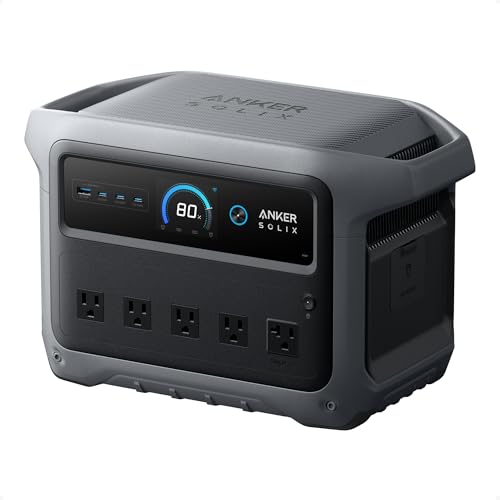
- 49 Min UltraFast Recharging: With upgraded HyperFlash tech, fully recharge at 1,600W—for outage prepping, camping trips, or tailgating events. Enable it in the Anker app.
The SOLIX C1000 is the newest addition to my collection, and it’s quickly become my favorite for serious use. At 1056Wh with LiFePO4 batteries rated for 3,000 cycles, this is a buy-it-for-life unit. Anker’s build quality is immediately noticeable; everything feels solid and well-engineered.
The 1000W continuous output (1400W surge) means I can run our Starlink setup, camp lights, phone chargers, and still have headroom. The 100W USB-C port charges my laptop fast, and the display is clear and accurate about remaining runtime.
What sold me on this over competitors at the same price point was Anker’s reputation and the LiFePO4 battery chemistry. I’ve owned enough portable power stations now to know that battery quality determines whether you have a useful tool or an expensive paperweight in two years.
This one’s built to last, and after several months of regular use during hurricane season prep and camping trips, it performs flawlessly every time.
Why I Picked It: When you want premium build quality, long-term reliability, and enough power for serious off-grid use, Anker delivers without compromise.
BLUETTI AC180
Best For: High-wattage loads, power tools, extended outages, heavy-duty backup
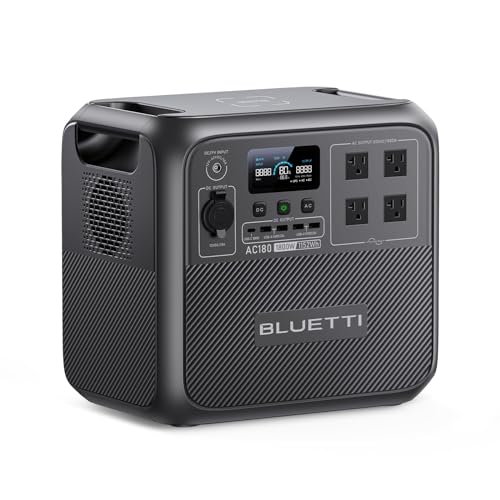
- [Charged in 1 Hour] – The AC180 packs a 1152Wh LiFePO4 battery, which can be fully charged in just 1 hour at 1440W AC input – always ready to go when you need it.
- [Power All Your Needs] – The AC180 boasts 1800W output and 8 outlets to handle almost anything you plug in. With a tap on the BLUETTI App, you can give it a boost to 2700W for your higher needs.
After my first BLUETTI died at 14 months, I swore off the brand. But the AC180 brought me back—and it’s been worth it. This uses LiFePO4 batteries (3,500+ cycle life), which is completely different from my failed unit.
At 1152Wh and 35.6 pounds, it’s serious hardware for serious power needs. The 1800W output means I can run power tools, a microwave, or keep multiple devices charged during extended outages.
I’ve had this for two years now and it’s performed flawlessly through multiple hurricane scares, countless camping trips, and regular testing. The battery shows zero degradation.
The AC180 can handle heavy loads that would shut down smaller units. I’ve run our full-size blender, charged power tool batteries, and kept our internet setup running during a 3-day power outage without breaking a sweat. Yes, it’s heavy, but that’s the trade-off for this much reliable power.
Why I Picked It: When you need serious wattage and bulletproof reliability during extended outages or off-grid camping, this delivers professional-grade performance.
DJI Power 1000
Best For: Fast recharging, quiet operation, tech-heavy setups, drone users
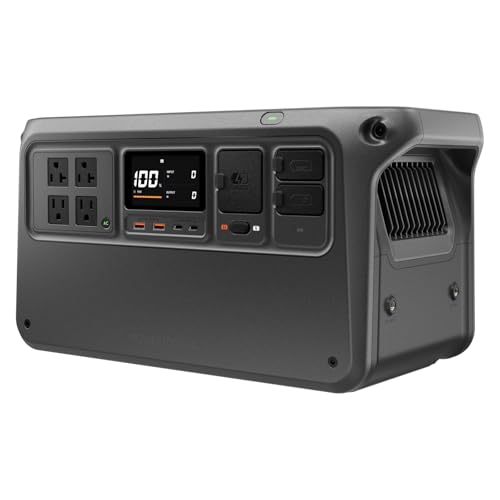
- Power More Than Ever – DJI Power 1000 V2 is a high-capacity solar generator that powers 99% [11] of appliances like kettles, cookers, projectors, saws, and drills—ideal for camping, DIY, and outdoor work.
- Charge Fast, Go Far – DJI Power 1000 V2 portable power station recharges to 80% in just 37 minutes [3], so you’re always ready for road trips, outdoor adventures, or emergency backup without long waits.
My buddy runs the DJI Power 1000 and I’ve used it on several camping trips. What stands out is that DJI’s approach to design everything is intuitive and well thought out, just like their drones. At 1024Wh with LiFePO4 batteries, it has the longevity I look for.
The 2200W output is impressive, and the fast charging (70 minutes to 80%) has saved us when we forgot to charge the night before a trip.
The SDC lite port is unique to DJI and charges their drones incredibly fast, which is why he bought it. But I’ve been impressed by how quietly it runs and how accurate the display is about remaining runtime.
During a recent camping trip, we powered Starlink, several laptops, camp lights, and a portable fridge for two days on a single charge. The build quality feels premium—nothing creaks or flexes, and the handles are comfortable even when it’s fully loaded.
Why I Picked It: If you want cutting-edge fast charging and whisper-quiet operation wrapped in DJI’s legendary build quality, this is worth the premium price.
EcoFlow DELTA 2
Best For: Rapid recharge times, expandable systems, flexible camping and home backup
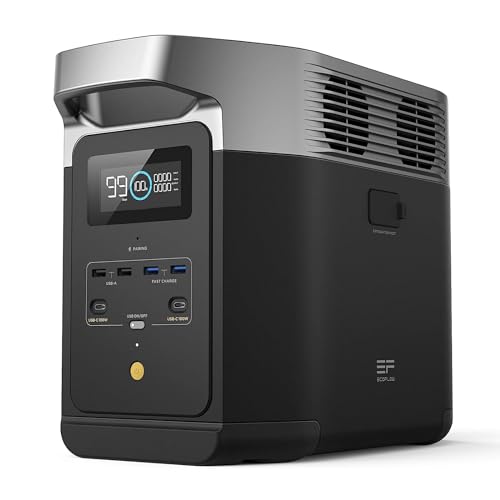
- 7 X Faster Charging. 0-80% in just 50 mins and 0-100% in 80 mins with AC input. That’s ideal when you need home backup power and a quick charge using your wall outlet.
- Expandable Capacity from 1-3kWh. With the standalone portable power station sporting 1kWh, you can add on extra batteries to reach up to 3kWh. Ideal for camping, RVs or off-grid living.and a quick charge using your wall outlet.
Another friend in our camping group has run the DELTA 2 for over a year, and it’s been bulletproof. At 1024Wh with LiFePO4 batteries, it matches competitors on paper, but EcoFlow’s X-Stream fast charging (80% in 50 minutes) is legitimately game-changing.
We’ve shown up at campsites, realized the power station wasn’t charged, and had it ready to go before we finished setting up tents.
What makes the DELTA 2 special is expandability—you can add extra batteries to reach 3kWh total capacity. My friend hasn’t added batteries yet, but knowing the option exists makes this future-proof.
The 1800W AC output handles everything we throw at it, and the app control is actually useful (unlike some competitors where the app feels tacked on). Multiple USB-C ports mean everyone can fast-charge their devices simultaneously.
Why I Picked It: When you want blazing-fast recharge times and the option to expand capacity later, EcoFlow’s engineering delivers impressive performance.
Pecron E2000LFP
Best For: Maximum capacity per dollar, whole-home essentials, budget-conscious buyers who still want LiFePO4
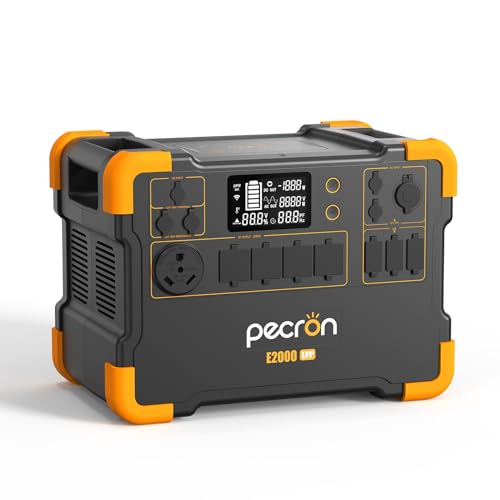
- Portable Power Station — [MASSIVE CAPACITY]: The E2000LFP power station With the 1920Wh Expandable to 8064Wh capacity 2000 watt rated power, is a good backup battery used for home use and outdoor activity, such as camping, tourism, fishing, and emergency, etc.
- Portable Power Station — [SAFETY & DURABLE]: The ultra-safe LiFePO4 battery with Built-in BMS assures the self-protection of short circuits, overload, and overheating. 110V Pure-sine wave inverter makes sure there is no damage to your sensitive electronic devices.
I haven’t personally owned this one, but it consistently shows up in my research as the best value option that still uses LiFePO4 batteries. At 2048Wh, it’s double the capacity of my Jackery 1000 but typically costs only slightly more. The 2000W continuous output (4000W surge) means it can handle serious loads during power outages—refrigerators, microwaves, power tools, medical equipment.
What makes pecron interesting is they’re newer to the market but using the right battery chemistry and matching the specs of units that cost $500-800 more.
Reviews from long-term owners show solid reliability, and the brand has responsive customer service. The trade-off is weight (48 pounds) and a less refined user interface compared to premium brands. But if your priority is maximum capacity and battery longevity per dollar spent, this delivers.
Why I Picked It: When you need massive capacity with LiFePO4 reliability but don’t want to spend $2,000+, this is the value champion.
BLUETTI Elite 100 V2
Best For: Portable LiFePO4 power, weekend camping, daily-use backup without excess weight
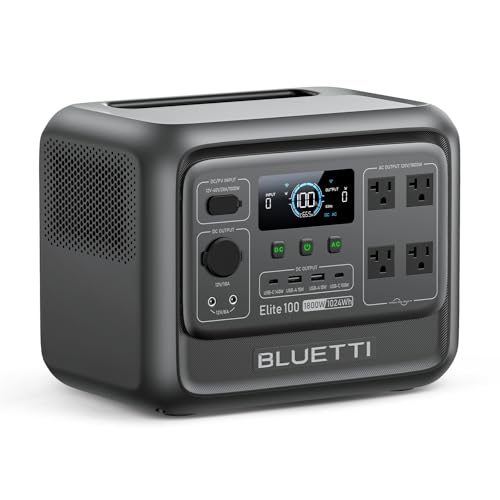
- [Power 11 Devices] – With a 1024Wh capacity, Elite 100 V2 portable power station delivers 1800W AC output (2700W Lifting Power) and 11 ports, ideal for outdoor camping, RV, and remote work.
- [35% Smaller, 30% Lighter] – Elite 100 V2 weighs 25 lbs and is compact at 17L. Grab it one-handed by the hidden handle for easy transport, from home office to campsite and off-grid cabin.
At 1036Wh and only 24 pounds, the Elite 100 V2 hits a sweet spot between my Jackery 300 (too small for serious use) and my AC180 (too heavy for frequent moving). A camping buddy swears by this for weekend trips where he wants serious capacity without the bulk.
The LiFePO4 batteries mean it’ll outlast cheaper units by years, and the 1000W output handles most camping and emergency needs.
What’s impressed me watching him use it is the build quality—BLUETTI clearly learned from earlier models. The handle design is comfortable, the display is easy to read in bright sunlight, and the cooling fans are quieter than my AC180.
Multiple USB-C PD ports (100W) make it great for charging laptops and tablets fast. The wireless charging pad on top is convenient for phones without fumbling for cables.
Why I Picked It: When you want premium BLUETTI quality in a more portable package, this delivers serious capacity without the serious weight.
GROWATT HELIOS 3600W
Best For: Whole-home backup, multi-day outages, hurricane preparedness, solar-heavy setups
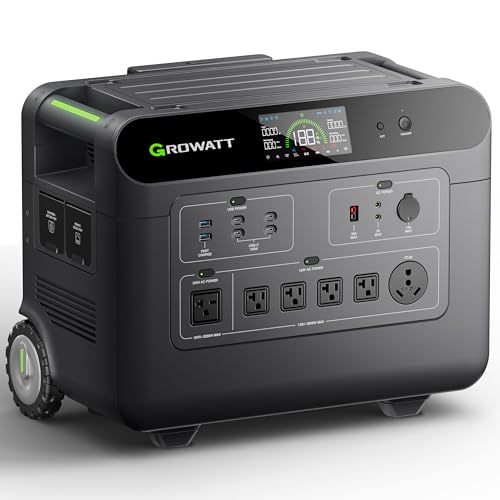
- 【Eligible for 30% Tax Credit】The HELIOS 3600 qualifies for the Residential Clean Credit for qualified solar electric property. Please check eligibility & requirements for Residential Clean Energy Credit programs with your utility provider.
- 【Tremendous Power at Your Reach】The Plug & Play 3684.6Wh battery with 3600W AC output (4500W with Watt+) supports 99% of daily essential appliances for a relatively long time. 16 versatile output ports make it ideal for RVs and home emergencies.
This is overkill for camping, but for hurricane season in South Carolina, units like this are becoming essential. At 3600Wh capacity and 3600W continuous output, the HELIOS can run your critical home systems during extended outages.
I’ve seen this in action at a friend’s house during our last storm—it powered their refrigerator, internet setup, fans, lights, and medical equipment for over 24 hours on a single charge.
The LiFePO4 batteries are rated for 3,500 cycles, and at this price point (and weight—it’s 88 pounds), you’re making a 10-year investment.
The unit supports solar panel input up to 2000W, so you can essentially go off-grid indefinitely with the right setup. It’s too heavy and expensive for casual camping, but for serious emergency preparedness or running a remote work setup during outages, this is professional-grade equipment.
Why I Picked It: When you need legitimate whole-home backup power that can keep your family comfortable and connected during multi-day outages, this is serious insurance.
My Real-World Buyer Guide to Portable Power Stations
After owning and using portable power stations for years—through camping trips, storm season, and real power outages—I’ve learned that most buying advice focuses on the wrong things. Specs and marketing look impressive, but they rarely tell you how a unit performs when you actually need it.
Here’s what matters in the real world.
Battery Chemistry Matters More Than Capacity
If a power station doesn’t use LiFePO4 batteries, I treat it as a short-term solution. Standard lithium-ion units still work, but they degrade faster and lose usable capacity over time. For emergency preparedness, hurricane season, or long-term ownership, LiFePO4 isn’t a nice feature—it’s the baseline.
Fast Recharge Is More Important Than Oversized Capacity
A massive battery doesn’t help if it takes all day to recharge. In real use—whether you’re between storms, moving campsites, or catching a short window of generator or solar power—recharge speed determines how useful your power station actually is. A 1,000Wh unit that recharges in under an hour often beats a much larger unit that stays empty.
Noise and Fan Behavior Matter More Than Reviews Admit
Some power stations look great on paper, but become unbearable when fans ramp up under load. Quiet, predictable cooling matters when you’re sleeping nearby or riding out a storm indoors. Every unit here manages heat without sounding like a shop vac.
Continuous Output Is What Really Counts
Ignore inflated surge ratings. What matters is continuous output—the wattage a power station can sustain without shutting down. This is what keeps refrigerators running, Starlink online, and medical devices stable. Every unit in this guide delivers honest, usable power.
Weight Isn’t a Flaw—It’s a Trade-Off
Lighter units are easier to move. Heavier units usually mean larger batteries, better cooling, and more robust internals. Decide whether your power station will live in a vehicle, a garage, or a single room during outages, then choose accordingly.
Trust the Brand, Then Scale the Size
If a company builds a reliable power station at one capacity, you can usually scale up or down within that lineup with confidence. That’s why this guide focuses on brands I trust, not just individual models. Capacity can change. Engineering quality doesn’t.
What Actually Matters
Portable power stations aren’t impulse buys anymore. When storms knock out the grid or you’re relying on one to keep your family connected, reliability matters more than marketing claims. Buy quality once, stick with proven brands, choose LiFePO4 batteries for long-term use, and you’ll be prepared for whatever the next storm—or road trip—throws your way.
If there’s one takeaway from this guide, it’s this: buy quality once, stick with proven brands, and choose battery technology that’s built to last.

Blair Witkowski is an avid watch nut, loves pocket knives and flashlights, and when he is not trying to be a good dad to his nine kids, you will find him running or posting pics on Instagram. Besides writing articles for Tech Writer EDC he is also the founder of Lowcountry Style & Living. In addition to writing, he is focused on improving his client’s websites for his other passion, Search Engine Optimization. His wife Jennifer and he live in coastal South Carolina.